

Breadcrumb
Facilities
At Cal Poly Humboldt, Geography students learn in both the classroom and the field. Our location on California’s North Coast provides direct access to forests, watersheds, coastlines, and nearby communities, while our on-campus labs and student spaces support mapping, geospatial analysis, environmental research, collaboration, and project-based learning.
Department Office: FH 109
Here you will find the main office for the Department of Geography, Environment & Spatial Analysis, including the offices of the Department Chair and the Administrative Support Coordinator. Students visit the office for information about major requirements, course scheduling, faculty office hours, general support, and checking out research and field equipment for classes and projects.
Kosmos Lab: FH 106
Kosmos is the technology and teaching lab designed to support Geography's cartography courses, integrate mapping and web applications throughout the geography curriculum, complement existing Humboldt remote sensing and GIS labs, and link geography majors with students from other departments sharing an interest in mapping with a strong design component.
Software available for student use includes GIS packages (ArcGIS Pro, QGIS) and design software (Adobe Creative Suite).
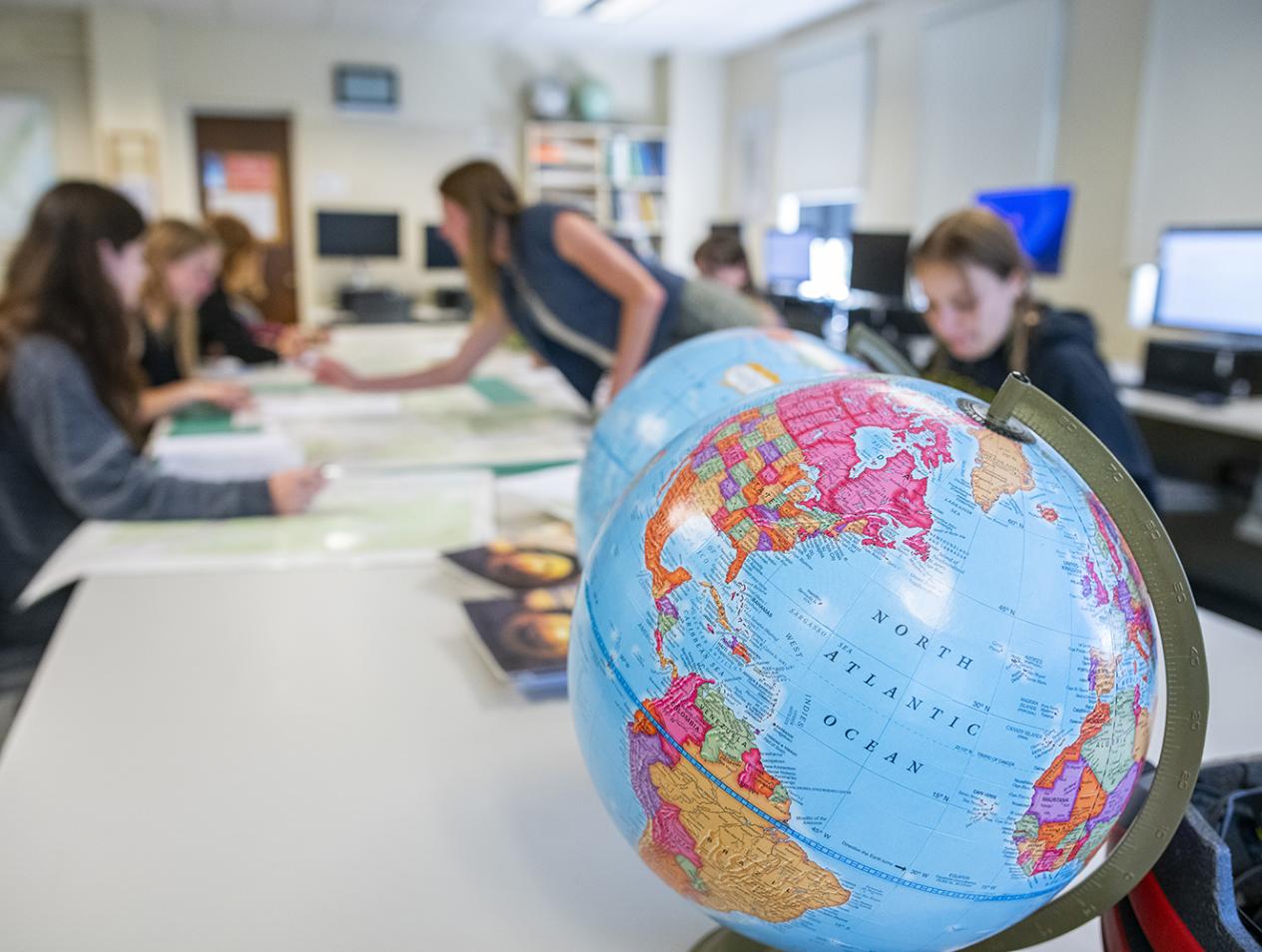
Harper Room: FH 126
This room is named after former Humboldt geographer Dr. John L. Harper, who served 27 distinguished years in the department starting in 1971. Designed for student study and meetings, it is outfitted with a conference table, atlas stand, whiteboard, and projection screen, and a full complement of geography journals, books, course reserve readings, and other resources.
Human Geography Research Lab: FH 103
The Human Geography Lab supports research in the areas of qualitative methods, human geography, community-based research, and spatially informed social inquiry.
The facility includes dedicated space for conducting qualitative research, video and audio equipment for interviews, five computer workstations, qualitative analysis software, and a field equipment stockroom that students can access for research projects.
Dendroecology Lab
The Dendroecology Lab supports research in the areas of physical geography, vegetation and disturbance ecology (fire, insect outbreaks and other disturbances), dendroecology, landscape ecology and geospatial analysis.
The facility includes tree-ring measuring systems, field and lab equipment, computers and instrumentation to support research with graduate and undergraduate students.
Institute for Spatial Analysis, Modeling, and Monitoring (ISAMM)
The Institute for Spatial Analysis, Modeling, and Monitoring (ISAMM) provides equipment and the opportunity for students to engage in high impact geospatial research with equipment including Unmanned Aerial Vehicles (UAVs/Drones).
Fieldwork Sites
Campus Farm
The Campus Farm is a 26-acre property in the Arcata Bottoms that provides students with space to conduct fieldwork in environmental data collection, long-term ecological monitoring, and applied geospatial fieldwork. This fieldwork and data collection can help establish important baselines for the new property and guide its future development.
L.W. Schatz Demonstration Tree Farm
Donated in 1987 by Dr. L.W. Schatz, the 385-acre L.W. Schatz Demonstration Tree Farm, located 45 minutes east of campus, is managed by the Department of Forestry, Fire & Rangeland Management, and provides an important field site for geospatial analysis and applied environmental research. The property provides students and researchers with opportunities to conduct spatial data collection, landscape analysis, and long-term monitoring, while supporting field-based learning in forestry, ecology, and geospatial science.
Library Special Collections & Archives
Special Collections & Archives supports archival and historical geographic research through access to maps, photographs, newspapers, pamphlets, and other primary source materials documenting the region and the university’s past. These collections provide students with valuable resources for investigating landscape change, place-based history, and the spatial dimensions of social and environmental change.